
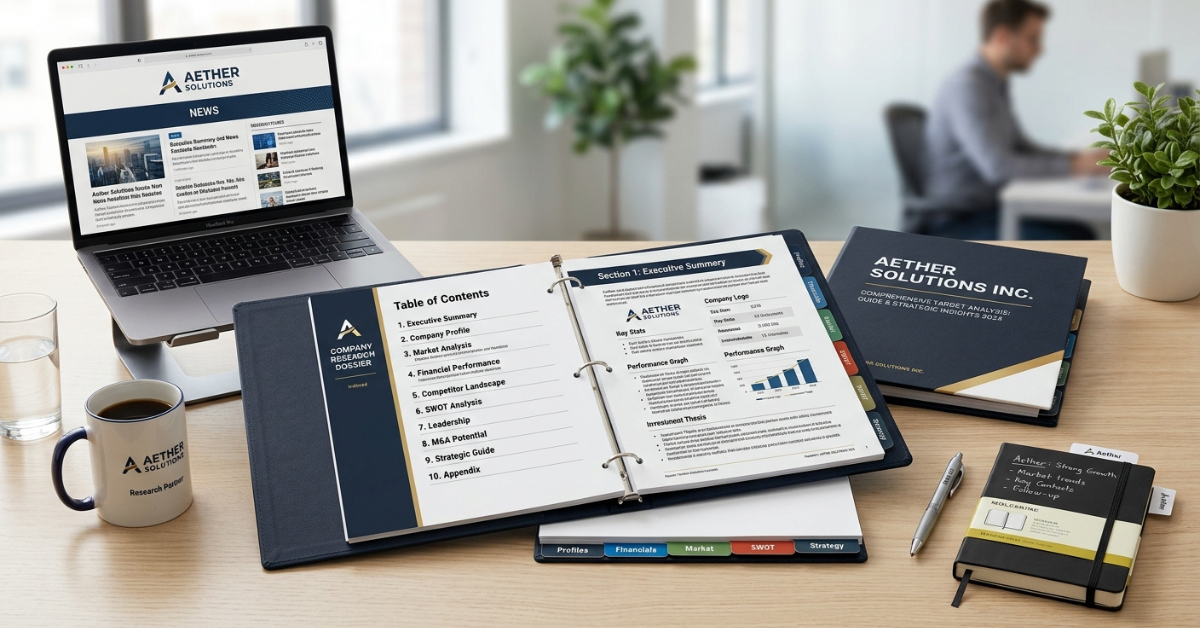
Before applying for a job, approaching a potential client, investing in a business, or starting a partnership, it helps to know exactly who you are dealing with. A research dossier for target company brings important information into one organized document, making it easier to understand a company’s background, market position, competitors, opportunities, and potential risks.
Unlike a quick Google search, a research dossier goes deeper. It combines company information, industry research, financial or business indicators, leadership details, competitors, customer insights, and other relevant findings into a structured profile.
Whether you’re a researcher, job seeker, business analyst, marketer, freelancer, or entrepreneur, knowing how to build a useful company dossier can save time and lead to better decisions.
What Is a Research Dossier for a Target Company?
A research dossier for target company is a structured collection of information and analysis about a specific organization.
Think of it as a company intelligence file. Instead of keeping research scattered across websites, articles, spreadsheets, social media pages, and reports, you bring the most useful information together in one place.
A company research dossier may cover:
- Company history and background
- Products or services
- Leadership and key decision-makers
- Target customers
- Industry and market position
- Competitors
- Business model
- Financial information
- Recent news and developments
- Online presence
- Strengths and weaknesses
- Potential opportunities
- Business risks
- Sources and supporting evidence
The exact structure depends on why the research is being conducted.
Why Is a Company Research Dossier Important?
Research becomes much more useful when it has a clear purpose. A well-prepared dossier can help someone understand a company without repeatedly searching for the same information.
For example, a job candidate could use company research to prepare for an interview. A salesperson could use it to understand a potential client before making contact. A business analyst could use the same type of research to compare companies within an industry.
A good dossier can help you:
- Understand the company’s business model.
- Identify important decision-makers.
- Study competitors and market trends.
- Discover potential opportunities.
- Identify possible risks.
- Prepare for meetings or interviews.
- Support business and marketing decisions.
- Keep important research organized.
How to Create a Research Dossier for Target Company
Creating a useful dossier does not mean collecting every piece of information you can find. The goal is to collect relevant, reliable, and current information.
1. Start With the Company Profile
Begin with basic information that establishes what the company is and what it does.
Include details such as:
- Official company name
- Founded date, if available
- Headquarters
- Locations or geographic markets
- Industry
- Company size
- Main products or services
- Website
- Official social media accounts
- Parent company or subsidiaries, if relevant
This section provides the foundation for the rest of the dossier.
2. Research the Company’s History
A company’s history can reveal how its current position developed.
Look for major milestones such as:
- Founding
- Major product launches
- Acquisitions
- Mergers
- Rebranding
- Expansion into new markets
- Major partnerships
- Leadership changes
- Important awards or recognitions
Avoid relying solely on the company’s own description. When possible, compare company claims with independent sources.
3. Analyze Products and Services
Understanding what a company sells is essential to understanding its business.
Create a list of its primary products or services and consider:
- What problem does each product solve?
- Who is the target customer?
- What makes the offering different?
- How is it priced?
- Which markets does it serve?
- Is the product positioned as premium, affordable, specialized, or mass-market?
This section becomes particularly useful when comparing the company with competitors.
Target Market and Customer Analysis
A strong company research dossier should explain who the company is trying to reach.
Depending on the business, customers may be individuals, businesses, government organizations, or a combination of several groups.
Research:
- Customer demographics
- Geographic markets
- Business segments
- Customer needs
- Purchasing behavior
- Common customer problems
- Customer reviews and feedback
- Major customer groups
Customer reviews can provide useful clues about real-world experiences, but they should be treated as individual opinions rather than definitive evidence about the entire company.
Competitor Research and Market Position
No company operates in isolation. Competitor research helps put the target company’s performance and strategy into context.
Start by identifying its direct competitors. Then look at indirect competitors that offer alternative solutions to the same customer problem.
Compare factors such as:
| Area | Target Company | Competitor |
|---|---|---|
| Products | Main offerings | Alternative offerings |
| Pricing | Price structure | Competitor pricing |
| Target market | Primary audience | Primary audience |
| Geographic reach | Key markets | Key markets |
| Brand positioning | Market message | Market message |
| Online presence | Website/social activity | Website/social activity |
| Key strengths | Identified advantages | Identified advantages |
The purpose isn’t simply to declare one company better. Instead, the comparison should show where each business is positioned and how they differ.
Leadership and Key People
Leadership research can provide important context about a company’s direction.
Depending on the organization’s size, investigate:
- CEO
- Founder
- Executive team
- Department heads
- Board members
- Major investors, where publicly documented
- Relevant spokespersons
For each important person, record their role and publicly documented professional background.
When researching individuals, stick to professional information relevant to the company’s operations. Avoid including private or unrelated personal details.
Business Model Analysis
One of the most valuable parts of a company dossier is understanding how the business makes money.
Ask questions such as:
- What does the company sell?
- Who pays for its products or services?
- Is revenue based on subscriptions, one-time purchases, advertising, licensing, commissions, or another model?
- Does the company sell directly or through distributors?
- Does it serve businesses, consumers, or both?
- What are its main revenue-generating products?
Understanding the business model can make other research findings much easier to interpret.
Financial and Business Performance
If reliable information is publicly available, include relevant financial indicators.
Depending on the company, this might include:
- Revenue
- Profit or loss
- Funding
- Valuation
- Stock performance
- Growth figures
- Employee numbers
- Annual reports
- Investor information
Not every company publicly releases detailed financial information. Private companies, in particular, may have limited publicly available data.
When information is unavailable, clearly state that rather than filling the gap with estimates presented as facts.
SWOT Analysis for the Target Company
A SWOT analysis can turn raw research into a quick strategic overview.
Strengths
These are internal factors that may give the company an advantage, such as:
- Strong brand recognition
- Specialized expertise
- Established customer base
- Unique products
- Strong distribution network
Weaknesses
These are internal limitations that may affect the organization, such as:
- Limited geographic reach
- Product gaps
- High operating costs
- Dependence on a small number of products
Opportunities
External developments may create opportunities through:
- Emerging markets
- New technologies
- Changing customer preferences
- New product categories
- Geographic expansion
Threats
Potential external challenges can include:
- New competitors
- Regulatory changes
- Economic conditions
- Changing consumer behavior
- Supply-chain problems
- Technological disruption
A SWOT analysis should be based on evidence collected during the research rather than assumptions.
Online Presence and Digital Footprint
A company’s online presence can reveal how it communicates with customers and positions its brand.
Review:
- Official website
- Blog
- YouTube
- Other relevant platforms
- Search visibility
- Online reviews
- Digital advertising
- Recent media coverage
Pay attention to patterns rather than individual posts. For example, regular product announcements may indicate an active marketing strategy, while a recently redesigned website could suggest a change in positioning.
Recent News and Developments
A company dossier can quickly become outdated, so recent developments deserve their own section.
Search for developments involving:
- New products
- New partnerships
- Acquisitions
- Leadership changes
- Expansion
- Layoffs
- Legal disputes
- Regulatory developments
- Funding
- Major contracts
- Industry changes
Always include dates when reporting recent events. This makes it clear whether information describes the company’s current situation or an earlier period.
Sources for Company Research
The quality of a dossier depends heavily on its sources.
Useful sources may include:
- Official company website
- Annual reports
- Regulatory filings
- Government databases
- Stock exchange information
- Reputable business publications
- Industry reports
- Academic research
- Professional associations
- Company press releases
- Verified professional profiles
Social media and online forums can provide useful leads, but important claims should ideally be checked against stronger sources.
Keep a Source List
At the end of your dossier, maintain a source list containing:
- Source name
- Article or document title
- Publication date
- URL
- Date accessed
- Relevant information obtained
This makes the research easier to verify and update later.
Common Mistakes When Creating a Company Dossier
Even detailed research can become less useful when it’s poorly organized.
Avoid these common mistakes:
Using Outdated Information
A company’s leadership, products, financial position, or strategy can change quickly. Always check publication dates.
Depending on One Source
One website rarely tells the complete story. Compare information from multiple credible sources.
Confusing Claims With Facts
A company may describe itself as an industry leader, for example. That’s a company claim, not automatically an independently established fact.
Adding Too Much Irrelevant Information
A dossier isn’t meant to become a biography of everyone associated with the company. Focus on information that supports the research objective.
Failing to Cite Sources
Without sources, readers cannot easily verify important claims. Keep citations and research notes organized from the beginning.
Simple Research Dossier Template
If you’re creating your first dossier, this structure is a useful starting point:
- Executive Summary
- Company Overview
- Company History
- Products and Services
- Target Market
- Business Model
- Leadership
- Competitor Analysis
- Industry Overview
- Financial Information
- Digital Presence
- Recent News
- SWOT Analysis
- Risks and Opportunities
- Key Findings
- Sources and References
You can expand or shorten these sections depending on the purpose of the research.
How to Make a Company Dossier More Professional
A professional dossier should be easy to scan.
Use:
- Clear headings
- Short paragraphs
- Tables for comparisons
- Bullet points
- Dates
- Source citations
- Charts where appropriate
- Consistent formatting
- A concise executive summary
Most importantly, separate verified facts, company statements, analyst interpretations, and your own observations. This makes the document much more credible.
Who Can Use a Research Dossier?
A company research dossier isn’t limited to professional researchers.
It can be useful for:
- Job seekers
- Recruiters
- Sales teams
- Marketing professionals
- Freelancers
- Investors
- Entrepreneurs
- Journalists
- Students
- Business analysts
- Consultants
- Researchers
For example, a job seeker could use a dossier to understand a company’s services, culture, recent projects, and leadership before an interview.
Frequently Asked Questions
What is a research dossier for a target company?
A research dossier is an organized document containing important information about a company, including its history, products, market, competitors, leadership, financial information, risks, and opportunities.
What should a company research dossier include?
A typical dossier includes a company overview, business model, products and services, target market, competitors, leadership, financial information, industry trends, recent news, SWOT analysis, and research sources.
How do you research a target company?
Start with the company’s official website and public records. Then compare information with reputable news outlets, industry publications, regulatory sources, professional profiles, and other reliable references.
How long should a company dossier be?
There is no fixed length. A basic company profile might be a few pages, while detailed due-diligence research can be considerably longer. The appropriate length depends on the purpose and complexity of the company.
Is a company dossier the same as a SWOT analysis?
No. A SWOT analysis is one component that can be included in a company dossier. A full dossier covers a much wider range of information.
How often should a company research dossier be updated?
Update it whenever there are significant changes, such as leadership changes, new products, acquisitions, financial announcements, or major market developments. For active research, reviewing it regularly helps prevent outdated information.
Conclusion
A well-prepared research dossier for target company turns scattered information into a practical research resource. Instead of simply collecting facts, it helps you understand how a company operates, who it serves, where it competes, and what developments may affect it.
The most important principle is accuracy. Use reliable sources, record dates, distinguish company claims from independently verified information, and keep the dossier focused on its purpose.
Whether you’re preparing for an interview, evaluating a potential business relationship, conducting market research, or studying an industry, a structured company dossier gives you a clearer starting point for your next step.
