

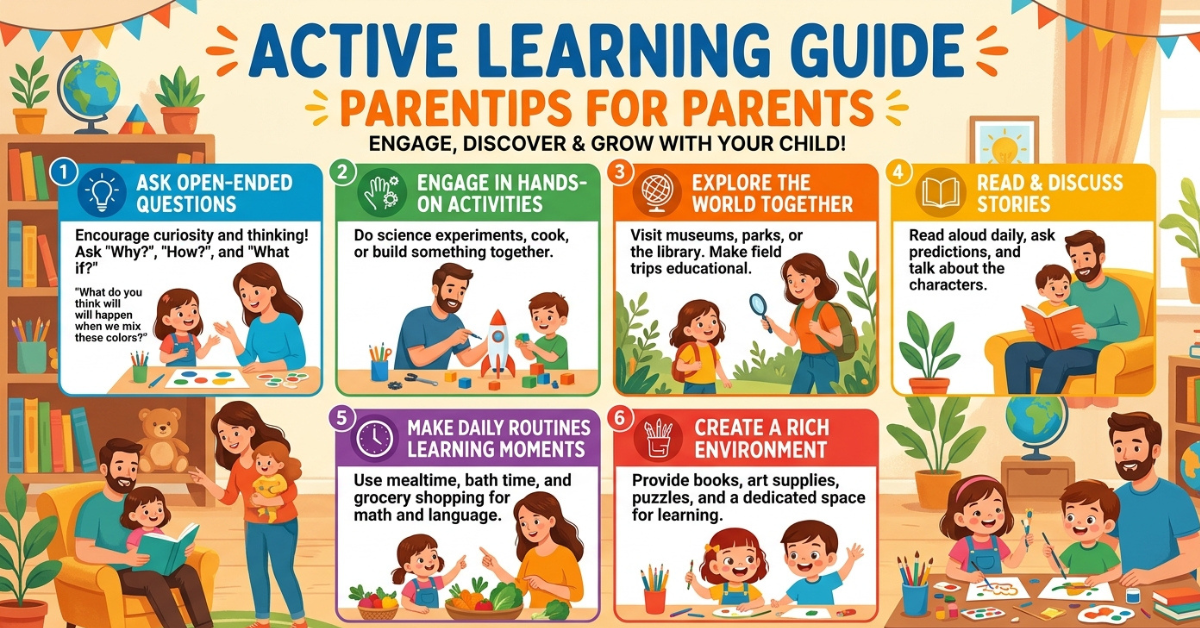
A child does not need a classroom, workbook, or expensive educational toy to start learning. Sometimes, learning begins with a simple question at the kitchen table, a failed block tower, or a walk around the neighborhood.
The active learning guide fparentips focuses on this idea: children learn more meaningfully when they participate, explore, question, create, and solve problems rather than simply receiving information. FParentips also presents active learning as something parents can incorporate into ordinary family routines rather than treating it as another demanding task on an already busy schedule.
Active learning is not about making every moment educational. It is about recognizing the learning opportunities that already exist in everyday life and giving children enough freedom to think for themselves.
What Is Active Learning?
Active learning is an approach in which learners participate directly in the learning process. Instead of only listening to an explanation or memorizing information, children may:
- Ask questions
- Discuss ideas
- Experiment
- Build and create
- Solve problems
- Explain their thinking
- Make predictions
- Test different solutions
- Reflect on what they discovered
The concept applies in classrooms, but it can also work beautifully at home.
For example, instead of simply telling a child that some objects float and others sink, a parent can place several safe household objects in water and ask the child to predict what will happen. The child then observes the result and discusses why the prediction was right or wrong.
That small activity involves observation, prediction, experimentation, and reasoning.
Active Learning vs. Passive Learning
The difference is easier to understand with a simple comparison.
Passive learning might involve:
- Listening to a long explanation
- Watching educational content without interaction
- Copying information
- Repeatedly rereading material
Active learning can involve:
- Explaining an idea in your own words
- Solving a practical problem
- Asking questions about a story
- Conducting an experiment
- Building a model
- Applying a lesson to real life
Neither reading, listening, watching, nor direct teaching is automatically bad. The important point is to give children opportunities to think and respond, rather than expecting information to stick simply because they heard it.
Research on active learning is particularly strong in education. A major 2014 meta-analysis examined 225 studies in undergraduate STEM courses and found higher examination performance in active-learning classes than in traditional lecture settings. However, those findings concern university students and should not be treated as direct evidence that every home activity will produce the same results for young children.
Why Active Learning Matters for Children
One of the biggest advantages of active learning is that it encourages children to become participants in their own education.
Instead of constantly waiting for an adult to provide the answer, children gradually learn to ask, “How can I figure this out?”
That shift can support several important skills.
1. Problem-Solving Skills
Give a child a challenge with more than one possible solution, and you create an opportunity for genuine problem-solving.
A simple building challenge, for example, could ask a child to construct a bridge from paper that can hold several small objects.
The child might fail the first time. That’s useful.
They can change the design, test it again, and compare the results. The lesson is not simply about building a bridge; it is about testing ideas and responding to evidence.
2. Critical Thinking
Active learning encourages children to question information instead of accepting everything immediately.
Parents can ask:
- “What makes you think that?”
- “How could we find out?”
- “What might happen next?”
- “Is there another way to solve it?”
- “What would happen if we changed this?”
These questions encourage children to explain their reasoning.
3. Better Memory and Understanding
Active participation can also support memory.
Research involving elementary-school children has found benefits from retrieval practice—asking children to recall information rather than simply studying it again. In one study involving 88 children, retrieval practice improved later recall compared with repeated study.
Another study with children aged 8–12 found that retrieval practice improved recall of newly learned geographical facts, with benefits still appearing after delays of several days or weeks.
This gives parents a useful practical idea: after reading or discussing something, ask your child to explain what they remember without immediately looking back at the material.
4. Confidence and Independence
When children discover that they can solve a problem without an adult immediately stepping in, they develop a stronger sense of independence.
That does not mean parents should leave children struggling indefinitely. Instead, provide support when needed while allowing the child to do as much of the thinking as they reasonably can.
How Parents Can Create an Active Learning Environment
You do not need to redesign your house into a classroom.
A good active learning environment can be surprisingly simple.
Create a Curiosity-Friendly Space
Keep a few age-appropriate materials accessible to your child, such as:
- Paper and crayons
- Building blocks
- Puzzles
- Books
- Measuring cups
- Cardboard boxes
- Magnifying glasses
- Safe household objects for sorting
- Craft materials
Open-ended materials are particularly useful because there is no single way to use them.
A cardboard box can become a house, vehicle, shop, robot, or anything else a child imagines.
Allow Children to Make Mistakes
Mistakes are a normal part of learning.
If a child builds a tower and it collapses, the immediate reaction does not have to be, “Let me fix it.”
Instead, try:
“Why do you think it fell?”
Then allow the child to experiment with another design.
This turns failure into information.
Ask More, Explain Less
Parents naturally want to help. Sometimes that means answering a question immediately.
But there are moments when another question is more useful.
Instead of:
“The plant needs sunlight.”
Try:
“Where do you think we should put the plant? Why?”
The second approach invites the child into the reasoning process.
Active Learning Activities for Different Ages
Active learning does not look the same for every child. Activities should match the child’s age, abilities, interests, and safety needs.
Toddlers: Ages 1–3
At this stage, simple sensory and sorting activities can provide plenty of learning opportunities.
Try:
- Sorting socks by color
- Pouring water between safe containers
- Naming objects during a walk
- Building towers with large blocks
- Matching household objects
- Looking at picture books and discussing images
For example, while sorting laundry, ask your child to find all the blue items. You can then introduce concepts such as color, size, quantity, and matching.
Preschoolers: Ages 3–5
Preschool children are often ready for simple experiments and more imaginative challenges.
Ideas include:
- Sink-or-float experiment: Ask them to predict which safe objects will float.
- Plant-growing project: Let them observe how a seed changes over time.
- Story endings: Stop before the ending and ask what they think will happen.
- Building challenge: Ask them to create the tallest stable tower they can.
- Shape hunt: Look for circles, squares, rectangles, and triangles around the home.
The goal is not to turn play into formal schoolwork. Keep the experience playful.
School-Age Children: Ages 6–9
Older children can handle activities that involve several steps.
Try:
- Baking using a recipe
- Planning a simple family outing
- Comparing prices at the grocery store
- Creating a household budget exercise
- Building structures
- Measuring objects around the house
- Keeping a simple weather journal
- Researching an animal and presenting what they learned
Cooking is especially useful because it naturally combines reading, measurement, sequencing, time, and science.
Use Everyday Activities as Learning Opportunities
One of the most useful ideas in the active learning guide fparentips is that learning does not have to be separated from everyday family life. FParentips describes ordinary activities such as cooking, grocery shopping, laundry, play, and outdoor exploration as potential learning moments.
Here are some easy examples.
Grocery Shopping
Ask your child to:
- Count apples
- Compare package sizes
- Find items by color
- Read simple labels
- Compare prices
- Help organize the shopping list
Cooking
Children can practice:
- Measuring
- Counting
- Following instructions
- Sequencing
- Observation
- Basic fractions
A recipe can become a practical math lesson without feeling like one.
Outdoor Exploration
A walk can become an opportunity to discuss:
- Plants
- Animals
- Weather
- Directions
- Shapes
- Colors
- Changes in the environment
The important thing is to follow the child’s curiosity.
If they suddenly ask why some leaves are yellow, you have a natural starting point for exploration.
Can Technology Support Active Learning?
Yes, but the way technology is used matters.
An educational video watched passively is different from using a digital resource as the starting point for exploration.
For example, after watching a short video about the solar system, ask:
- “Which planet interested you most?”
- “What do you remember about it?”
- “How is it different from Earth?”
- “What would you like to find out next?”
Technology can also support interactive simulations, digital storytelling, educational games, research, and creative projects.
The goal is not simply to increase screen time. It is to make digital experiences more interactive and purposeful.
Make Reading an Active Learning Activity
Reading does not have to be passive either.
Before reading a story, ask:
“What do you think this book will be about?”
During the story:
“Why do you think the character did that?”
Afterward:
“What would you have done differently?”
You can also ask children to retell the story in their own words.
These simple conversations encourage comprehension, prediction, recall, and reasoning.
The Parent’s Role: Guide Instead of Taking Over
Perhaps the most important change is the parent’s role.
You do not need to know every answer.
In fact, saying “I don’t know. Let’s figure it out together” can be an excellent learning moment.
A parent can act as:
- A question asker
- A supporter
- A resource provider
- A conversation partner
- A role model
- A source of encouragement
The objective is not to leave children completely on their own. Instead, provide enough support to help them move forward without automatically doing the thinking for them.
Encourage Productive Struggle
Suppose your child is working on a puzzle and gets stuck.
Before solving it for them, try:
- “Which pieces have you already tried?”
- “What do you notice about this piece?”
- “Could we try another corner?”
- “What might work differently?”
If frustration becomes too high, step in with appropriate help.
Active learning should challenge children without overwhelming them.
Common Mistakes Parents Should Avoid
Active learning can become less effective when parents put too much pressure on the child.
Avoid turning every activity into a test.
Also avoid:
- Correcting every small mistake immediately
- Asking questions so quickly that the child cannot think
- Choosing activities the child strongly dislikes
- Comparing one child’s progress with another’s
- Expecting every activity to produce an obvious academic result
- Using expensive products simply because they are marketed as educational
Children need room for curiosity, play, experimentation, and downtime too.
A Simple Active Learning Routine
If you’re not sure where to begin, keep it extremely simple.
Try this five-step approach:
- Notice: Pay attention to what your child is interested in.
- Ask: Use an open-ended question.
- Explore: Give them time to investigate.
- Discuss: Talk about what happened.
- Reflect: Ask what they would try next time.
For example, if your child builds a tower:
Notice: “You made a really tall tower.”
Ask: “What do you think would make it stronger?”
Explore: Let them change the design.
Discuss: “What changed when you moved that block?”
Reflect: “What would you do differently next time?”
That’s active learning without a worksheet.
Frequently Asked Questions
What does active learning mean for children?
Active learning means children participate in the learning process through activities such as questioning, experimenting, creating, discussing, solving problems, and applying information.
Is active learning better than traditional learning?
The evidence depends on the age, subject, activity, and learning environment. Strong research supports active learning in many educational settings, particularly in higher education, while research with children also supports specific active strategies such as retrieval practice. It is more accurate to view active learning as an important teaching approach rather than a replacement for every form of direct instruction.
How can parents use active learning at home?
Parents can incorporate it into ordinary activities such as cooking, shopping, reading, building, outdoor exploration, household tasks, and games. The key is encouraging children to participate and think rather than simply providing answers.
Does active learning require expensive educational toys?
No. Many useful activities can be done with household objects, paper, books, cardboard boxes, blocks, or materials already available at home.
How do I encourage a child who doesn’t want to learn?
Start with their interests instead of forcing a particular activity. If a child loves animals, for example, use animals as a starting point for reading, counting, drawing, research, or outdoor observation.
Can educational games count as active learning?
They can, particularly when children make decisions, solve problems, explain strategies, or apply what they learn. However, not every game marketed as “educational” automatically creates meaningful learning.
What should parents do when a child makes a mistake?
Give the child a chance to think about what happened. Ask questions such as, “What do you think went wrong?” or “What could we change?” When appropriate, offer guidance without immediately taking over.
Conclusion
The active learning guide fparentips centers on a simple but valuable idea: children learn through participation. Asking questions, solving problems, experimenting, creating, reading actively, and connecting lessons to everyday experiences can turn ordinary moments into meaningful learning opportunities.
Parents do not need to create a perfect learning environment or fill every day with educational activities. A few thoughtful questions, accessible materials, and enough freedom to experiment can go a long way.
Start small. During your child’s next activity, resist the urge to give the answer immediately. Ask one question, give them time to think, and see where their curiosity leads.
That small change can be the beginning of a much more engaging approach to learning.
